The CEO Walked Into His Office and Found Her Cryin…
The CEO Walked Into His Office and Found Her Crying Beside His Desk—Seconds Later, He Was in Shock
The CEO walked into his office and found her crying beside his desk.
Seconds later, he was in shock.
For 11 years, Paul Angstrom had walked into his building at 10 minutes 7 every weekday.
The routine never changed. Black coffee from the cafe on Washington Avenue.
The freight elevator because it was faster.
Fourth floor, where the old brick walls still showed faded stencled numbers from the days the place had stored grain.
Beyond the tall windows, the Mississippi moved slow and brown under a pale May sky.
Dealer meetings at 8. A supplier call at 10:00.
A lunch with the bank he had no intention of enjoying.
He was halfway down the hall before he noticed his office door was open.
Nobody opened that door before him.
Not Nenah, not the cleaning crew.
Then he heard it. A small broken sound.
The kind of crying a child does when she has been trying very hard not to.
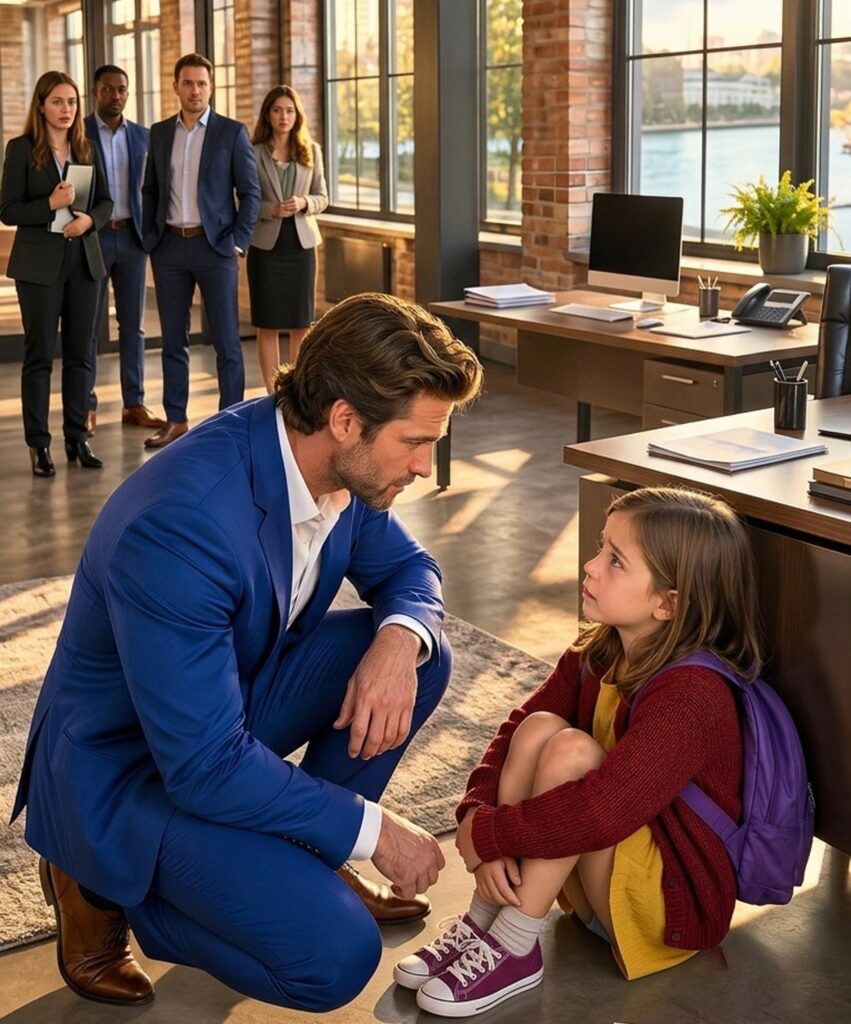
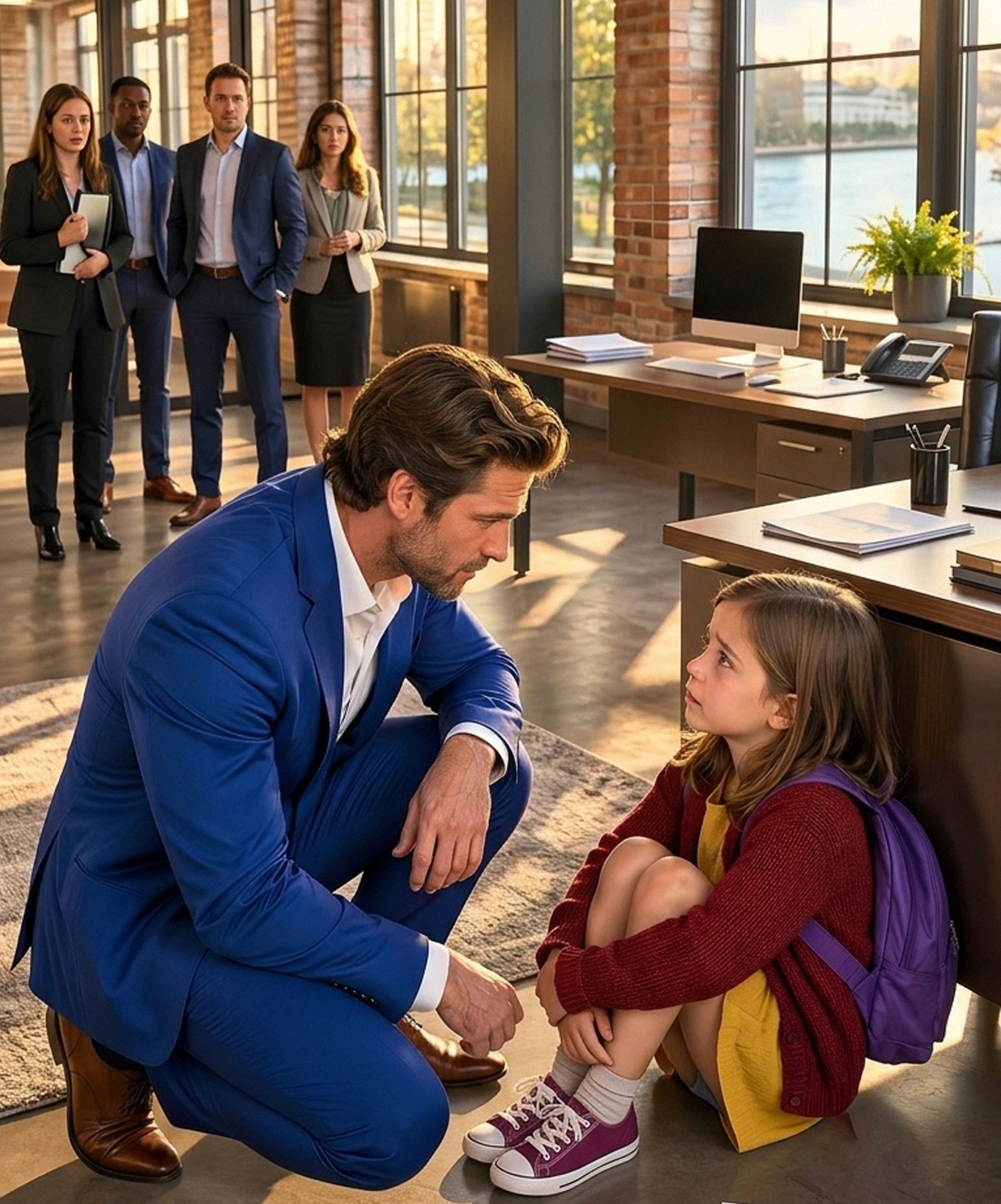
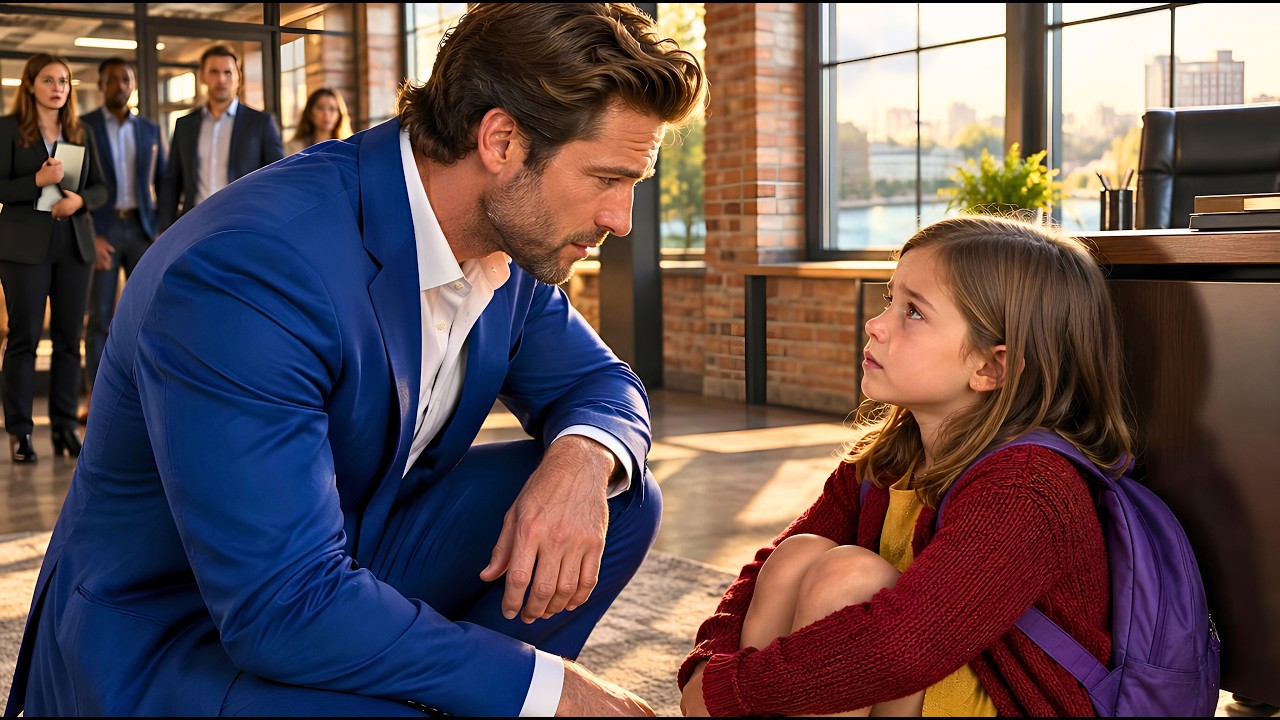
A little girl sat on the floor beside his desk, knees pulled up, a purple backpack still on her shoulders.
One hand pressed something flat against her chest.
Len Duffy stood just inside the door, turning his security cap slowly by the brim.
“Mr. Instrom,” he said quietly.
“I’m sorry, sir. I didn’t know where else to bring her.”
Len had guarded the lobby for 19 years.
He was not a man who rattled, but his eyes were tired in a way Paul had never seen.
What happened? 6:40 this morning, a woman comes in with this little one.
Hadn’t laid eyes on her in years.
Asks me to watch her girl for 20 minutes.
Len paused. Then she says, “If I’m not back, take her to Mr. Angstrom.
Nobody else.” And she didn’t come back.
No, sir. I called 911 at 7:00.
They’re sending someone, but the shift crowd started coming through, all those boots and voices, and she got scared.
He glanced at the girl.
She kept saying your name.
The girl lifted her head.
Her eyes were red and swollen, but steady.
She watched him the way children watch a stranger they’ve been told about.
Paul did not walk toward her.
He lowered himself onto one knee near the doorway, a good distance away, his hands resting open where she could see them.
“Hi,” he said. “I’m Paul.
What’s your name?” “Willaa.” Barely a whisper.
“That’s a good name, Willa.
Are you hurt anywhere?” She shook her head.
“Okay, Len’s going to stay right here with us, and some people are coming to help find your mom.”
She studied him for a long moment.
Then she held out what she’d been holding, a photograph, its corners soft and bent from living in a pocket.
Len took it gently from her small hand and passed it across.
Paul looked down and the room went still.
Mini haha falls. Summer. White water behind them.
Sunlight caught in the mist.
A woman with dark hair blowing across her face.
Laughing. Beside her, a man with one arm stretched toward the camera, grinning like someone with nowhere else he needed to be.
It was him, not the man who closed deals and left the building after dark.
A younger version, loose and unguarded, someone nobody in this building had seen in years.
And he knew exactly who had taken that picture.
He had arm out, phone tilted, while she teased him for being terrible at it.
Mommy said you’re the man in the picture, Willa said.
She said you keep your promises.
Paul couldn’t answer. Something had closed around his throat that he hadn’t felt in a very long time.
Footsteps in the hall. A Minneapolis police officer appeared.
Right behind her came Nah, coat still on, keys in hand, taking in the whole room in one look.
She didn’t ask a single question.
She crouched a little apart from Willa and said softly, “Hi, sweetheart.
You thirsty? I’ll get you some water.
While the officer spoke with Len, Nah stepped out to her desk.
Paul heard her typing. When she came back, she held a printed page and her face was careful.
Len gave me the mother’s name, she said.
Carla Novak. She worked here.
Contract software developer. She hesitated.
Her contract ended in the fall of 2019 in the downsizing.
Paul stared at the page.
I remember her,” he whispered.
His eyes darkened and he said nothing more because what he could not say, not in front of anyone, was this.
In the fall of 2019, Carla Novak had vanished from his life without a word.
And for nearly 7 years, he had believed she simply chose to walk away.
By 9:00, the dealer meetings had been cancelled, and the glass conference room down the hall had become something else entirely.
The door stayed open. Nah had made sure of that.
Willa sat at the long table with a paper cup of water and a granola bar she hadn’t touched.
Len in the chair beside her.
The officer stood by the window.
Paul sat across the table close enough to be present far enough not to crowd her.
The news came in small pieces and none of it was good.
Carla’s phone went straight to voicemail.
Officers had knocked at her apartment in Columbia Heights.
No answer. A neighbor said her car hadn’t moved in 2 days.
Paul turned to Len. You said you hadn’t seen her in years, but she trusted you with her daughter.
Len rubbed his thumb along the brim of his cap.
Back when she worked here, she brought me a coffee every morning.
Every single one. Said the man at the front desk ought to get something warm before the bosses did.
A faint smile came and went.
After she left, I’d get a Christmas card every year.
Always a school picture tucked inside.
He glanced down at Willa, then back at Paul.
Couple years ago, she wrote a line at the bottom.
If anything ever happens, would you look after her?
I wrote back, “Yes.” Didn’t think twice.
His voice dropped. Never figured she meant it.
Just before 10:00, a woman in a navy cardigan arrived with a laptop bag.
Janet Sunberg, county social worker.
She had the kind of calm that came from 20 years of hard mornings.
She knelt to Willa’s eye level first before she spoke to any adult in the room.
Then she went to work.
A call to Willa’s school.
A long conversation with Len in the hallway within sight of the door.
When she came back, she set a printed form on the table.
Carla listed Mr. Duffy as Willa’s emergency contact.
Janet said, “At school, at the pediatrician, everywhere.”
She planned for this. She looked at Len.
“If you and your wife are willing, Willa can stay with you for now.
I’ll check in everyday, and we’ll put a safety plan in writing.”
Len was already nodding. Arlene’s making up the spare room.
I called her an hour ago.
Willa had been quiet through all of it, watching every face.
Now she looked straight across the table at Paul.
“Did you love my mommy?”
The room went still. Paul felt the question land somewhere he had kept locked for nearly 7 years.
He could have smoothed it over, but she deserved the truth.
I think I was starting to, he said quietly, and then she was gone.
Willa considered that. Then she nodded as if it matched something she already knew.
Paul looked away toward the river.
He remembered that summer the way you remember a song you stopped letting yourself play.
A company volunteer day at a youth camp up on a lake.
A crew of employees building a new dock in the heat.
Carla on the far end of a plank telling him he was holding the drill wrong.
She was right. What followed was a few quiet months.
Walks along the river. Dinners with no phones on the table.
The picture at the falls.
Carla loved that place. She had once told him that when the city became too loud, the falls were where she went to hear herself think.
And then one night in early September, sitting in his car outside her building, she had asked him gently where he thought this was going.
He had answered honestly. That was the worst part.
I’m not built for a family, Carla.
This company is all I’ve got room for.
She hadn’t argued. She had just nodded, kissed his cheek, and gotten out of the car.
Two weeks later, her contract was cut in the downsizing.
Her number was disconnected. He had told himself she’d made her choice.
He had never once asked what she was carrying when she made it.
Janet’s phone buzzed on the table.
She picked up and stepped into the hallway.
Through the glass, Paul watched her listen.
He saw her hand rise slowly to her forehead.
She motioned him to the doorway and kept her voice low, meant for him alone.
Carla had been found on a light rail platform downtown, unconscious, alive.
An ambulance was taking her to Riverside Mercy.
Willa didn’t hear the words.
She didn’t need to. She was looking at the adults faces, at Len’s hands gone still on the table, at Paul standing in the doorway with the color drained from his face.
Her voice came out small and careful.
“Is my mommy going to die?”
Paul came back into the room slowly and sat down so his eyes were level with hers.
I don’t know yet, he said.
That’s the truth. But a lot of people are working very hard to help her right now, and you won’t be alone while they do.
Willa held his gaze. Then she reached for Len’s sleeve and didn’t let go.
Riverside Mercy Hospital sat on a hill above the river, all glass and pale brick.
The family waiting area outside the ICU was quiet in the way hospitals are quiet.
Soft shoes, low voices, a television nobody watched.
Willow was not allowed past the double doors.
Neither was Paul, so they waited.
Len sat on one side of her, Janet on the other.
Paul took the chair across the aisle, close enough to answer if she asked him anything.
More than once, he caught her looking over to make sure he was still there.
A little after 1, a doctor came through the doors.
Mid-40s, sleeves pushed up, tired eyes that hadn’t stopped caring.
“I’m Dr. Max Rivera,” he said.
“Are you Willa?” She nodded.
He crouched in front of her.
“Your mom’s body is very tired, so right now we’re helping it rest.”
“Can I see her?” “Not yet, but I’ll tell her you’re here.”
He straightened and looked at the adults.
Janet stayed with Willa. Paul and Len followed him to the end of the hall by a window out of her hearing.
Rivera didn’t soften it. “It was an overdose,” he said.
A transit worker found her on the platform and gave her Nlloxxone before the ambulance arrived.
“That man saved her life.
She’s breathing with support. The next 48 hours matter most.”
Rivera paused. Her records show 4 years in recovery.
It started with prescription painkillers after a car accident in 2021.
She did the work. Meetings, counseling, all of it.
Then what happened? Len asked.
She lost her job last month.
For a lot of people, that’s when the floor gives way.
Rivera looked toward the waiting area.
This was a relapse. It doesn’t erase 4 years.
It just means she’s human.
He nodded toward Willa. She got her daughter to safety before she fell.
In my work, that’s the bravest thing I see.
20 minutes later, Paul was at the hospital’s patient services desk with Nenah beside him.
She’d driven over with his laptop and the look she wore when she’d already guessed something.
He arranged a private room for when Carla left the ICU.
Then he spoke to the foundation office.
Every bill paid in full.
No name attached. She’s never to know it was me, he said.
In the hallway, Nah stopped.
Paul, I’ve worked for you for 14 years.
Her voice was gentle. You don’t just do this for anyone.
He met her eyes. For once, he didn’t reach for the polished answer.
She isn’t anyone. That evening, Len and Arlene’s little house in northeast Minneapolis smelled like chicken soup and old wood.
Arlene had met them on the front steps, a sturdy woman with silver hair pinned up and reading glasses on a chain.
She’d hugged Willa without a word and handed her a cup of cocoa already cooled with milk.
An upright piano stood against the living room wall, its lid closed, covered in framed photographs.
Janet had come and gone, leaving a printed safety plan on the kitchen table.
Arlene sat in her armchair across the room, shelling peas into a bowl, the lamp on.